
They are delicious on their own, renowned for their ability to spruce up a muffin, and make for a delicious pie.
But are blueberries also a super healing superfood?
Let’s check it out.
Here are the top seven reasons to start thinking about adding blueberries to your diet, straight out of the scientific journals.
Blueberries could help improve vascular function
There is actually a decent-sized body of scientific literature looking into blueberries’ potential to aid in vascular health. Such as the following:
- A systematic review published in Metabolites in 2022 found that blueberry consumption consistently decreased oxidative stress and improved endothelial function. [1]
- A meta-analysis published in The Journal of Nutritional Biochemistry in 2023 found that “blueberries may play a role in the improvement of markers of vascular function.” Importantly, blueberries’ effects on vascular function were observed both after eating and in the long term. [2]
- A systematic review and meta-analysis published in Frontiers in Physiology in 2024 found that blueberry consumption improved diastolic blood pressure and endothelial function. [3]
- A systematic review and meta-analysis published in Nutrition Research in 2026 found that while blueberry consumption did not result in significant changes to blood pressure, it did significantly improve flow-mediated dilation, an indicator of increased blood flow. [4]
Proper blood flow carrying vital nutrients and oxygen to our cells is a great way to kick off the rest of blueberries’ health benefits.
Which brings us to:
Blueberries might be able to improve cognitive function
Another area that has received some research attention is cognitive function. With so many affected by cognitive issues, especially as many age, this is obviously of huge importance.
Let’s check out the research.
- A meta-analysis published in The Journals of Gerontology in 2019 found that blueberry consumption may provide benefits for delayed memory, executive function, and psychomotor function in older healthy and mild cognitive impaired adults. [5]
- A systematic review published in Brain, Behavior, and Immunity in 2020 found that eight out of twelve reviewed studies “reported blueberry consumption or supplementation at various doses and time lengths to improve measures of cognitive performance, particularly short- and long-term memory and spatial memory.” [6]
- A systematic review of randomized controlled trials published in Scientific Reports in 2022 found that berry and berry supplement consumption have beneficial effects on resting brain perfusion (the amount of blood flow in the brain while at rest), cognitive function, memory performance, executive functioning, processing speed, and attention indices. [7]
- A systematic review published in CNS & Neurological Disorders Drug Targets in 2023 found that blueberries had a significant effect in two-back test accuracy (a measure of working memory). They also found however, no significant effect in attention task reaction time, percentages of attention task accuracy, or one-back test accuracy. [8]
- A systematic review of randomized controlled trials published in Systematic Reviews in 2024 found that children “showed improvement in immediate recall after supplementation with blueberries.” [9]
- A meta-analysis published in Biogerontology in 2025 found that blueberry consumption showed a statistically significant improvement in episodic memory as well as improved language memory in patients with mild cognitive impairment. [10]
Blueberries have some gut healing properties
A meta-analysis published in Molecular Nutrition & Food Research in 2023 found that blueberry consumption “improves gut health by improving intestinal morphology, reducing gut permeability, suppressing oxidative stress, ameliorating gut inflammation, and modulating the composition and function of gut microbes.” [11]
And speaking of oxidative stress…
Blueberries could help reduce oxidative stress and inflammation
Blueberries true power that might tie many of their other powers together could revolve around their anti-inflammatory and oxidative stress-reducing potential. Here is some of the science:
- A systematic review published in Metabolites in 2022 found that blueberry consumption consistently decreased oxidative stress and improved endothelial function. [1]
- A systematic review published in Nutrients in 2023 found that blueberry consumption resulted in reduced inflammation in subjects with metabolic syndrome. [12]
But on the other hand…
- A meta-analysis published in Food & Function in 2024 found that berries did not reduce exercise-induced inflammation and oxidative stress. [13]
Now that does not necessarily negate the other positive results, especially considering “exercise-induced” oxidative stress is a unique category of stress. But it is worth noting.
Blueberries could help improve cholesterol
Although not entirely conclusive, the weight of the evidence seems to point at blueberries’ potential to help lower LDL and total cholesterol. For example:
- A meta-analysis published in Nutrition Research in 2021 found that blueberry consumption significantly decreased total cholesterol and LDL cholesterol. [14]
- A meta-analysis and systematic review published in Food & Function in 2022 found that blueberry consumption “showed a significant improvement in systolic and diastolic blood pressure, triglycerides, total cholesterol, low-density lipoproteins (LDL), (and) high-density lipoproteins (HDL).” [15]
However, not all studies found the same results:
- A systematic review and meta-analysis published in Frontiers in Physiology in 2024 found that blueberry consumption did not show significant effects on LDL or HDL cholesterol. [16]
So, from the current standpoint, it appears blueberries might be helpful, but also not necessarily a sure-fire fix.
Blueberries could help control blood sugar
This is a big one. Blueberries are often touted as a fruit suitable for those with type 2 diabetes as it is one of the lower sugar-containing fruits. But is that just scratching the surface? Can blueberries do more than simply provide a low-sugar option among fruits? Let’s check it out.
- A systematic review published in Critical Reviews in Food Science and Nutrition in 2019 found that blueberry extract or powder supplementation “showed a beneficial effect on glucose control in T2DM subjects.” They found the same for cranberry juice. [17]
- A meta-analysis published in BMJ Nutrition, Prevention & Health in 2021 found an inverse association between blueberry consumption (among other fruits) and type 2 diabetes. [18]
- A systematic review and meta-analysis of randomized clinical trials published in Nutrition, Metabolism, and Cardiovascular Diseases in 2022 found that blueberry and cranberry consumption significantly reduced fasting blood glucose and glycated hemoglobin. [19]
On the other hand, there are some dissenting findings:
- A meta-analysis and systematic review published in Food & Function in 2022 found that blueberry consumption “had no significant effect on waist circumference, body mass index (BMI), glycated hemoglobin (HbA1C), glucose level and homeostatic model assessment for insulin resistance (HOMA-IR)”. They did find significant improvements in insulin levels, however. [20]
The weight of the findings, though, appear headed in the direction of blueberries having a positive impact on blood sugar, but again, not necessarily a sure-fire fix all on their own.
Blueberries could help boost immune function
A meta-analysis was published in Phytomedicine in 2026 and found that dietary polyphenols, including those found in blueberries, consistently enhanced natural killer cell activation and cytotoxicity, modulated T cell subsets, and improved innate immune functions such as phagocytosis (when cells engulf and digest things like bacteria, dead cells, and debris) and chemotaxis (the directing of immune cells to where they need to go). [21]
Blueberries could help you lose weight
And how could we make this list without including everyone’s favorite?
Weight loss!
A meta-analysis published in Complementary Therapies in Medicine in 2020 found that among studies with a follow up time greater than six weeks, blueberry consumption (in this case blueberry powder or freeze dried blueberries) resulted in significant weight loss. [22]
Honorable mention: blueberries could help improve bone mineral density
A meta-analysis published in Nutrients in 2025 found that blueberry consumption showed modest benefits on whole-body bone mineral density, although they noted that clinical evidence was limited. [23]
Summary: Blueberries are pretty great
When we look at nutrition studies, we do not often see specifics that we want in terms of conclusions. Such as absolute proof that a certain amount of a food consumed at a certain frequency will yield a certain result. What we often see, however, is the direction of the evidence.
And for blueberries the direction is very good.
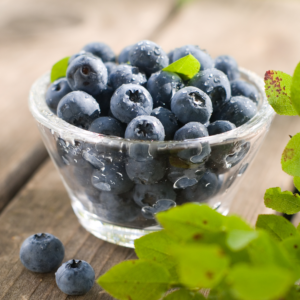
Blueberries are a delicious, widely available fruit that can be consumed by just about anybody. They are even diabetic-friendly (although if you are diabetic you need to consult with your licensed healthcare practitioner first before making changes to your diet and lifestyle).
And the range of blueberries’ benefits quite literally run from head to toe.
From helping support cognition, to blood flow, to gut health (from where much of health originates anyway) to boosting our immune systems and maybe even helping create stronger bones of all things, blueberries might be a do-it-all superfood that you can find affordably in the frozen food section of the grocery store.
That’s how I like to buy mine, anyway. They can be affordable, even when organic which is the best option whenever you can do it, and they often have better nutrients than even their fresh counterparts since they are typically frozen at the peak of freshness.
Fresh, while delightful, have often been picked long before they get to your table and sometimes go bad pretty quickly.
But, frankly, fresh, frozen, or dried, can all be delicious.
So if you think adding blueberries to your diet is right for you, make sure to talk to your licensed healthcare practitioner to ensure it is safe and appropriate for you and determine how best to do so.
And as always, here’s to your health!
If you agree that you can take your health back and become your best version of you, then please consider sharing that message with the world with some of this super comfy and stylish gear!
Almost all shirts are 100% cotton, which is a natural fabric that importantly allows your skin to breathe.
Yet another aspect of how simple some health solutions really are.
Click here and pick out your faves!

The statements contained on this website have not been evaluated by the Food and Drug Administration and are not intended to diagnose, treat or cure any disease. Do not consume anything written about on this website if you are allergic to it.
The opinions expressed herein are for informational and educational purposes only and are not intended as a substitute for professional medical advice, diagnosis and treatment. Please consult a physician or health care professional for your specific health care or medical needs.
Please talk to your doctor before beginning any exercise or diet program, including those found on this website. The information provided on this site is not intended as a substitute for consultations with your doctor nor is it intended to provide medical advice specific to your condition.
References
[1] https://pubmed.ncbi.nlm.nih.gov/36676944/
[2] https://pubmed.ncbi.nlm.nih.gov/36150681/
[3] https://pubmed.ncbi.nlm.nih.gov/38887319/
[4] https://pubmed.ncbi.nlm.nih.gov/41974068/
[5] https://pubmed.ncbi.nlm.nih.gov/30941401/
[6] https://pubmed.ncbi.nlm.nih.gov/30999017/
[7] https://pubmed.ncbi.nlm.nih.gov/35217779/
[8] https://pubmed.ncbi.nlm.nih.gov/35676847/
[9] https://pubmed.ncbi.nlm.nih.gov/38849879/
[10] https://pubmed.ncbi.nlm.nih.gov/40856863/
[11] https://pubmed.ncbi.nlm.nih.gov/37428472/
[12] https://pubmed.ncbi.nlm.nih.gov/37111125/
[13] https://pubmed.ncbi.nlm.nih.gov/38165220/
[14] https://pubmed.ncbi.nlm.nih.gov/34139510/
[15] https://pubmed.ncbi.nlm.nih.gov/35445669/
[16] https://pubmed.ncbi.nlm.nih.gov/38887319/
[17] https://pubmed.ncbi.nlm.nih.gov/29345498/
[18] https://pubmed.ncbi.nlm.nih.gov/35028521/
[19] https://pubmed.ncbi.nlm.nih.gov/35282984/
[20] https://pubmed.ncbi.nlm.nih.gov/35445669/
[21] https://pubmed.ncbi.nlm.nih.gov/41544470/